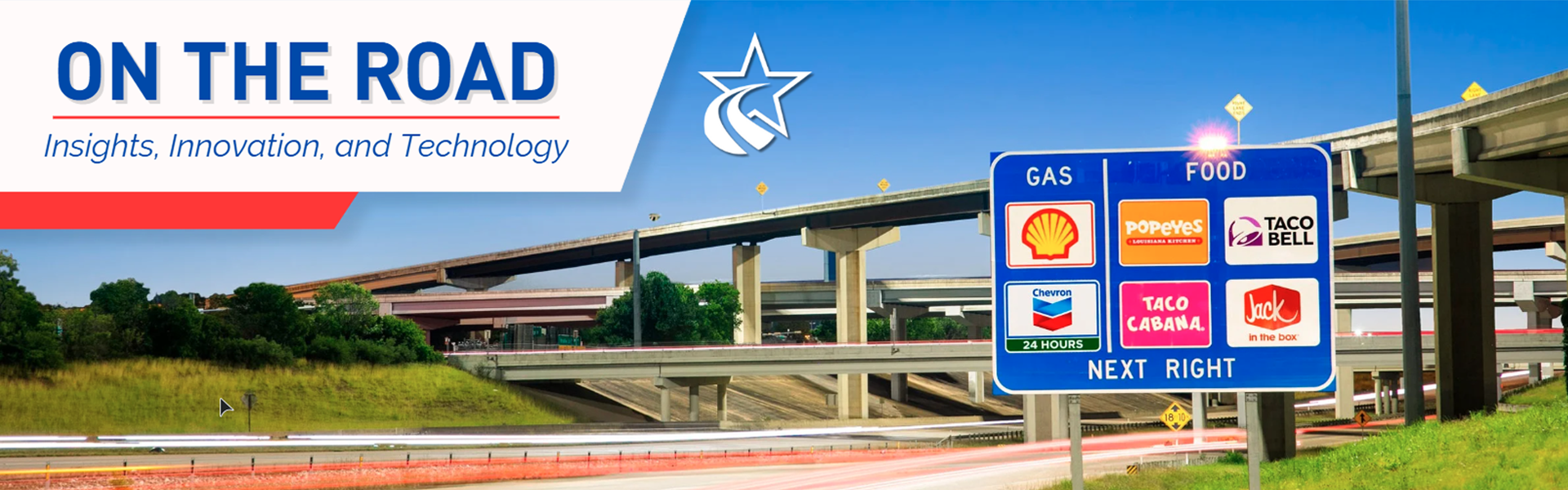


In the world of highway signage, small policy changes can lead to big improvements. One of the most impactful shifts in the history of the Specific Service Sign Program, better known as the Logo Program, came with the Federal Highway Administration’s “6-to-12” Interim Approval.
A Program Born in 1969
The Logo Program was created to help motorists find essential services like Gas, Food, Lodging, Camping, Attractions, and, later, 24-Hour Pharmacies. These blue signs have become a trusted link between travelers and the businesses that serve them.
The Manual on Uniform Traffic Control Devices (MUTCD) established the program’s structure. States could install up to four service signs per interchange, each dedicated to a single service category. Each sign could display up to six business logos.
That structure worked well for decades, but eventually it reached its limits.
The Problem of Growth
By the early 2000s, demand had outpaced available space. Popular exits near cities and tourist destinations filled quickly. Restaurants competed for limited Food logo spots, while Gas or Lodging panels often had vacancies. This created an imbalance. Travelers missed helpful information, businesses lost visibility, and states missed out on potential revenue.
Virginia’s Experiment
In 2004, the Virginia Department of Transportation (VDOT) proposed a practical solution. If the Camping sign at an interchange was unused, it could be replaced with an additional Food sign. If no Camping sign was present at all, a second Food sign could be added.
VDOT conducted a study including crash data and motorist surveys. The findings showed that adding more logos did not compromise safety. In fact, it improved the traveler experience by making more relevant information available.
Interim Approval IA-9: A Leap Forward
Based on VDOT’s findings, the FHWA issued Interim Approval IA-9, often referred to as the “6-to-12 Rule.” This allowed states to display up to 12 logo panels for a single service category, using two signs instead of one. Each sign was still limited to six panels.
This was a meaningful change. DOTs gained flexibility to respond to local demand. More businesses could participate. Travelers benefited from clearer, more complete service information at busy interchanges.
The rule also helped fix long-standing inefficiencies. In high-traffic areas, Food logos were in high demand while other service categories often had unused space. IA-9 gave states the option to reallocate that space where it was most needed.
Conditions and Safeguards
FHWA set important limits to ensure safety and consistency:
- A maximum of 12 logo panels per service category across two signs
- Each sign limited to six panels
- No more than four service sign structures per approach
- Each service type limited to two signs
- Service types must remain clearly separated to avoid driver confusion
States adopting the rule were also required to maintain a complete location inventory. They agreed to restore any sites if needed and to remove installations if safety concerns developed.
Why It Matters
The 6-to-12 rule was not just a change in numbers. It was an example of how data, innovation, and practical field testing can lead to smarter policies.
For DOTs, it opened new opportunities. Local businesses received better visibility and increased business. Travelers had access to more accurate and useful information.
It also expanded the economic potential of the program, allowing states to generate more revenue while improving the experience for road users.
Looking Ahead
The story of the 6-to-12 rule is a reminder that innovation often starts with a small problem. A policy designed in 1969 eventually reached its limits. Through state-level initiative and federal responsiveness, the program was modernized to meet new realities.
What began as a Virginia pilot became a national standard. It is a powerful example of how experimentation, data, and thoughtful adaptation can lead to real, measurable progress.
Want to learn more or inquire about partnering with us?